Guide · 3 min read
How to Date a Case XX Knife by Its Tang Stamp
Case has dated its knives with the tang stamp since 1940: XX, XX USA, the dots of the 1970s and 1980s, the long-tail C, and the X-and-dot system since 2000. How to read yours, and what the pattern number means.
Updated October 21, 2026 · Austin Blade Co., 7600 N Lamar Blvd, Austin
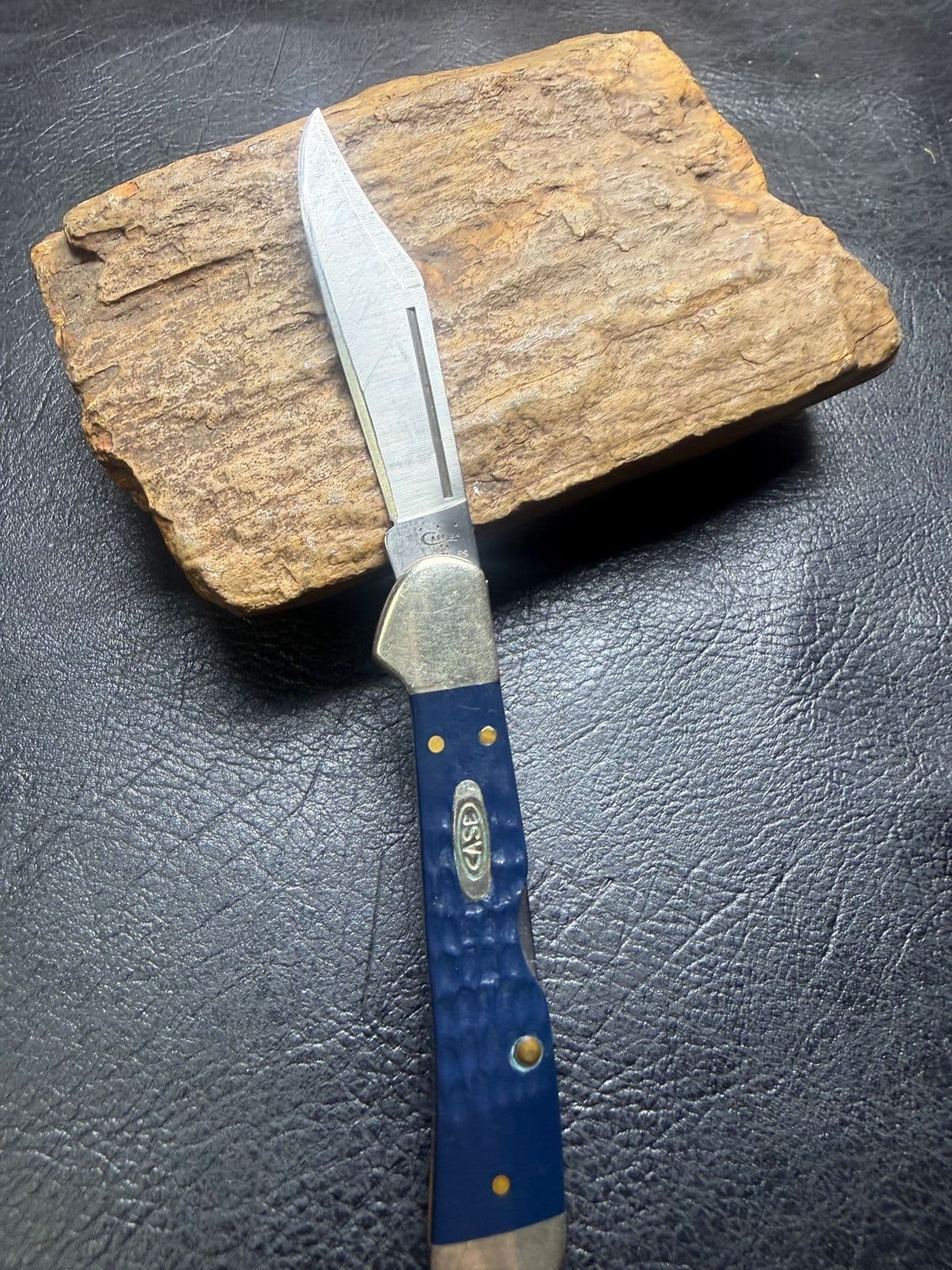
Every vintage Case knife carries its own birth certificate on the tang of the master blade. Open the main blade and look at the flat steel just above the pivot: the stamp there names the maker, and the way it is written narrows the knife to a decade, often to a year. Here is how we read them at the counter.
The eras, in order
CASE TESTED XX (1920s to 1940). The oldest stamp you are likely to meet. "Tested" sits above "XX", sometimes in a curve. Knives from this era are scarce and priced accordingly; most that come through our door have been sharpened hard.
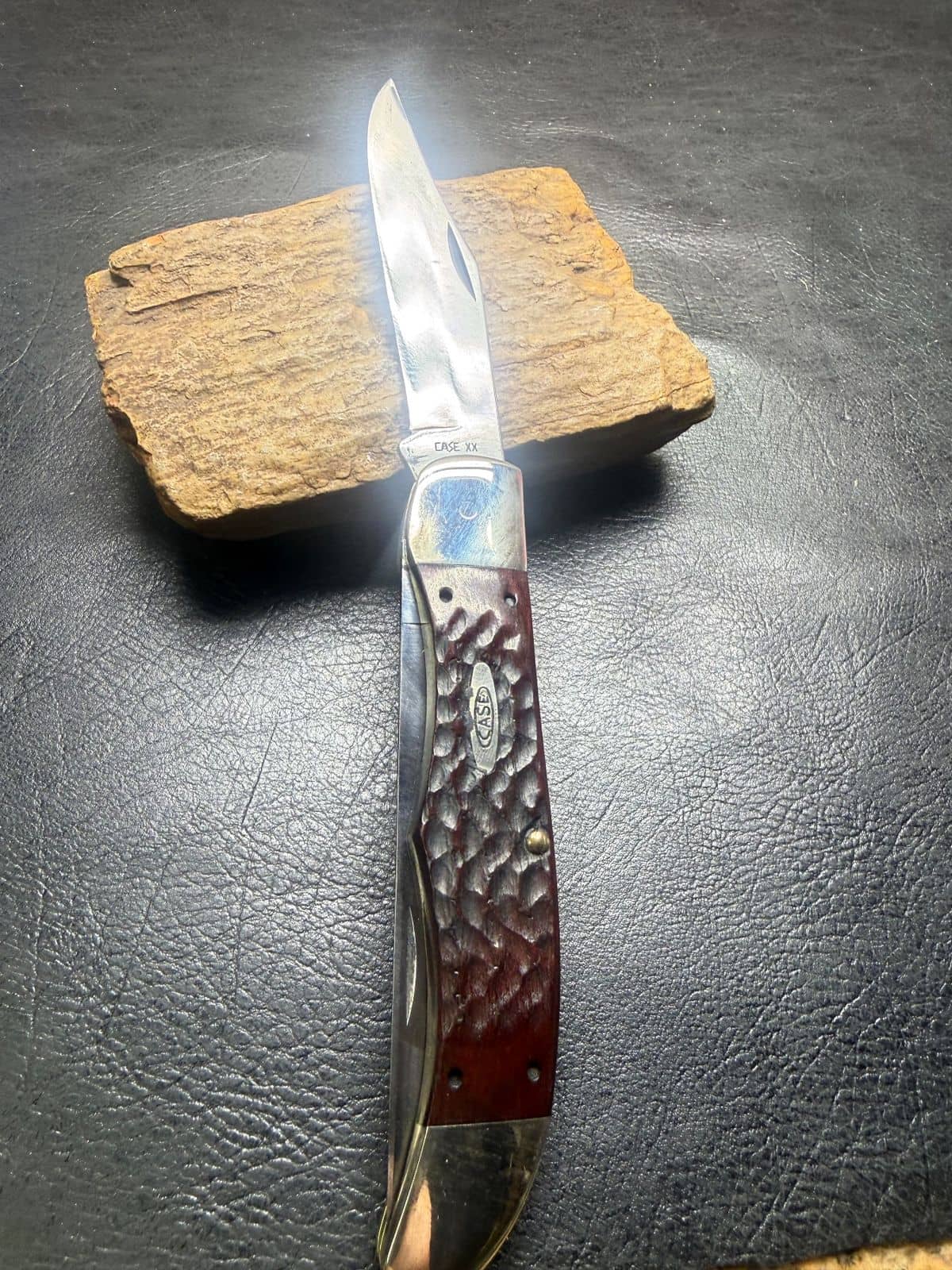
CASE XX (1940 to 1964). The plain "CASE XX" stamp without "USA". This is the golden era for collectors: bone handles from the old suppliers, carbon steel blades, patterns that have not changed since. A 1940s 6265 folding hunter in red bone is the knife people mean when they say "old Case".
CASE XX U.S.A. (1965 to 1969). "U.S.A." is added under the stamp. Same patterns, same quality; a little more common and a little less expensive.
The 10-dot stamps (1970 to 1979). In 1970 Case placed ten dots under "CASE XX U.S.A." and removed one dot every year. Ten dots is 1970, five dots is 1975, one dot is 1979. Count carefully: worn stamps hide dots.
The lightning S dots (1980 to 1989). The same countdown, but the "S" in CASE is drawn like a lightning bolt. Ten dots is 1980, one dot is 1989.
Dated stamps (1990 to 1993). For a few years the stamp carried the year itself, and in 1993 Case moved to a "long-tail C" logo with dots counting down from 1993 to 1999.
Dots and X's (2000 on). Each decade since 2000 starts with five X's and five dots. A dot is removed each year until 2005, then an X each year to 2009; the pattern repeats from 2010 and 2020. It looks cryptic, but it reads quickly once you know the rule.
If the stamp does not match any of these, the knife may be a Case Classic, a special issue or a contract knife. Bring it in.
Reading the pattern number
Under or beside the stamp is a number such as 6265, 6347 or 3254. It is not a serial number; it describes the knife.
| Digit | Meaning | Examples |
|---|---|---|
| First | Handle material | 2 black synthetic, 3 yellow synthetic, 5 stag, 6 bone, 8 pearl, 9 imitation pearl |
| Second | Number of blades | 1, 2, 3, 4 |
| Last two or three | Pattern | 65 folding hunter, 47 stockman, 54 trapper, 20 peanut, 18 stockman |
So a 6265 is bone, two blades, folding hunter. A 3254 is yellow synthetic, two blades, trapper. Letters after the number are blade and finish variations: SAB is a saber-ground master blade, SS is stainless, SH a sheepfoot blade.
What age does to value
Age alone does not set the price. A 1940s knife that has been sharpened to a sliver is a user; a 1970s knife with a full blade, crisp stamp and clean bone is a collectible. When we price a Case, we look at:
- How much blade is left, against a clean example of the pattern.
- Walk and talk: the snap at open and closed.
- Handles: cracks along the pins, shrinkage, replaced scales.
- The stamp itself: worn or buffed stamps lose both the date and the value.
- Box and papers, which matter more the newer the knife.
Our guide to judging a vintage knife goes through each check.
Bring it in
We date and value Case knives at the counter for free, and we buy and consign them. If you are selling a single knife or a drawer of them, tell us what you have or bring them to the store on North Lamar.
Shop the case
Common questions
- What does XX mean on a Case knife?
- It refers to Case's old 'XX' tempering process, in which blades were heat-treated twice. It has been part of the tang stamp since the 1920s and is the start of every Case stamp since.
- How do the dots on a Case knife tell the year?
- From 1970 Case put ten dots under the stamp and removed one each year: ten dots is 1970, one dot is 1979. The 1980s repeated it with a different stamp (the 'lightning S' in CASE). From 2000, dots and X's together count the year within each decade.
- What do the numbers on a Case knife mean?
- The pattern number. The first digit is the handle material (6 is bone, 5 stag, 3 yellow synthetic, 2 black synthetic), the second is the number of blades, and the last two or three are the pattern itself. A 6265 is a bone-handled, two-blade folding hunter.
- Can you date my Case knife for me?
- Yes. Bring it to the store on North Lamar and we will read the stamp and pattern with you. There is no charge.